Telecoms · Optical fibre
80 Gbit/s DWDM optical transmission
Design and OptiSystem simulation of an eight-channel, 10 Gbit/s-per-channel DWDM link over 50 km of fibre, comparing NRZ and RZ modulation, with and without an EDFA amplifier.
- 80 Gbit/s 8 channels of 10 Gbit/s on a single fibre
- 23.7 – 26.7 dB channel OSNR in NRZ without amplification
- RZ better error rate on every channel, at the cost of a wider spectrum
Screenshots
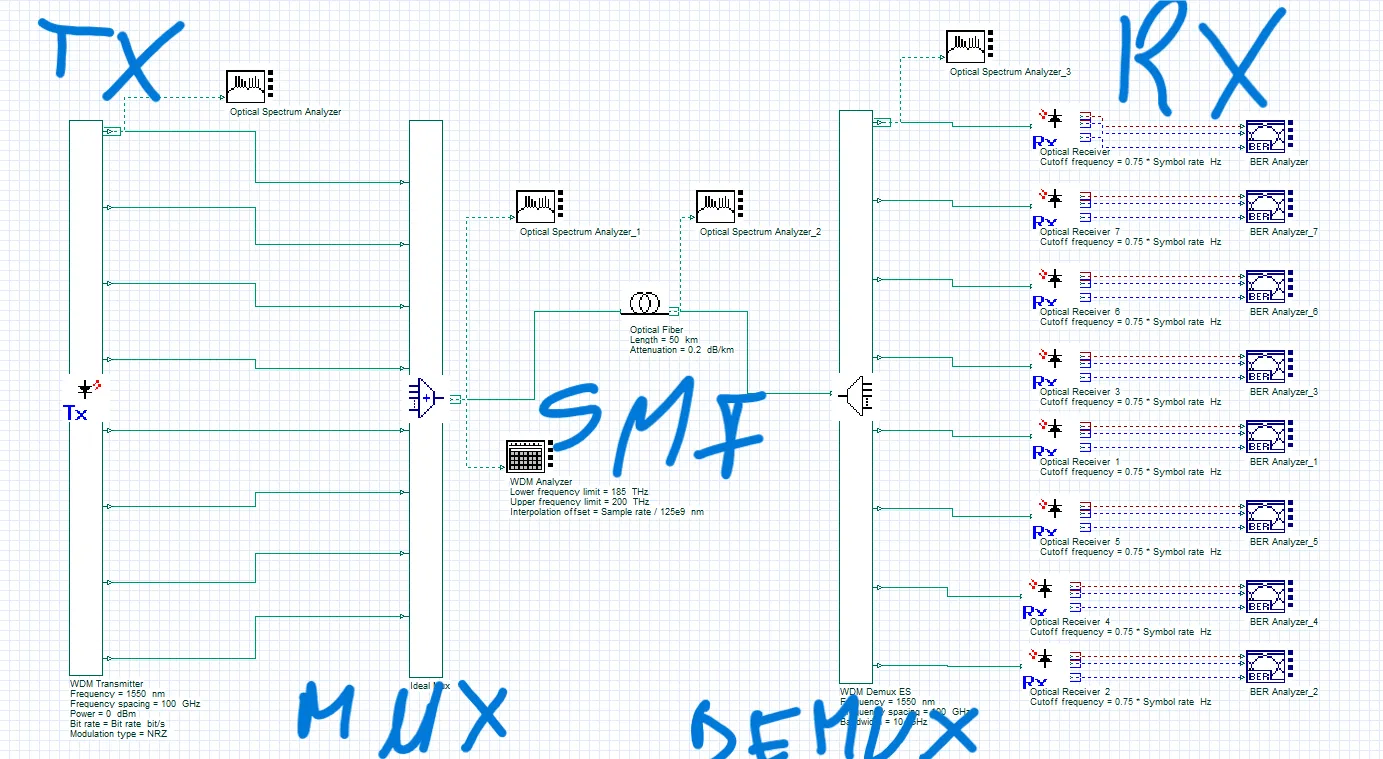
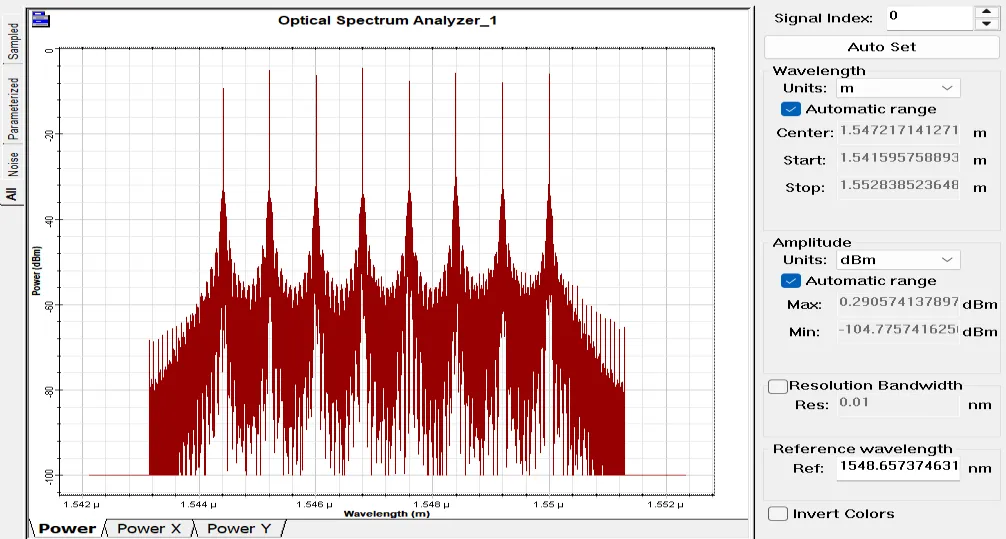
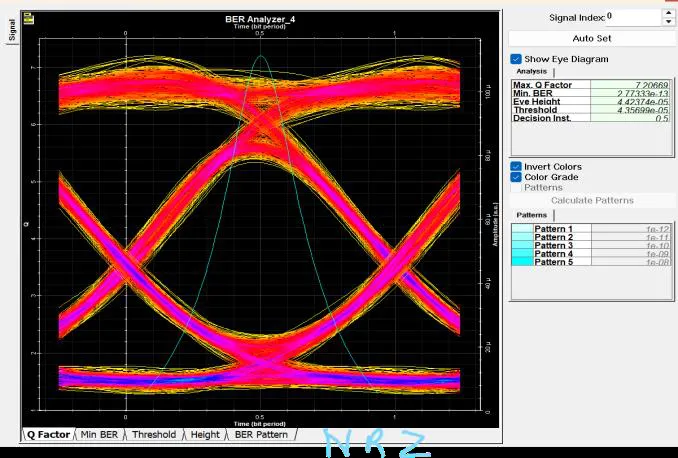
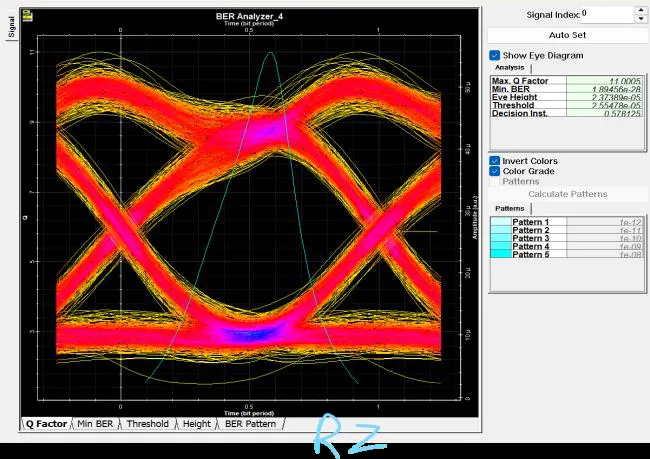
Screenshots taken from the project report. Simulation built in OptiSystem.
What this project shows
Choosing the modulation is a trade-off: RZ withstands dispersion better and gives a more open eye, NRZ stays simpler and more spectrum-efficient. The EDFA improves both and narrows the gap. These are simulation results.
Context, approach and architecture
Context
Dense wavelength-division multiplexing (DWDM) carries several channels on a single fibre and sits at the heart of operator backbones. The goal was to build a full 80 Gbit/s link and measure how the modulation format and amplification affect the received signal, without dispersion compensation.
Approach
-
Transmission: eight lasers spaced 100 GHz apart around 1,550 nm, modulated at 10 Gbit/s, then multiplexed onto 50 km of single-mode fibre (0.2 dB/km).
-
Reception: demultiplexing, PIN photodiodes, then per-channel bit error rate, Q factor and eye diagram.
-
Comparison of four configurations: NRZ or RZ, with or without an EDFA amplifier after the fibre.
Architecture
- 8 × 10 Gbit/s
- lasers and modulators
- MUX / DEMUX
- 100 GHz spacing
- Fibre SMF
- 50 km, no dispersion compensation
- EDFA
- optical amplification (second scenario)