Mobile networks · Cloud-native
5G Standalone core, Open5GS and UERANSIM
A full 5G core deployed on a single VM, with two network slices and an SDN controller, to understand a modern mobile architecture from the inside.
- 2 slices isolated on shared infrastructure
- 0% packet loss on both slices (measured in the lab)
- 1.8 / 10.5 Mbps received throughput (iperf3) for a 2 / 10 Mbps AMBR: each slice stays at its limit
- ÷ 3 MEC-slice latency (≈ 53 ms) versus the Internet slice (≈ 165 ms)
Screenshots
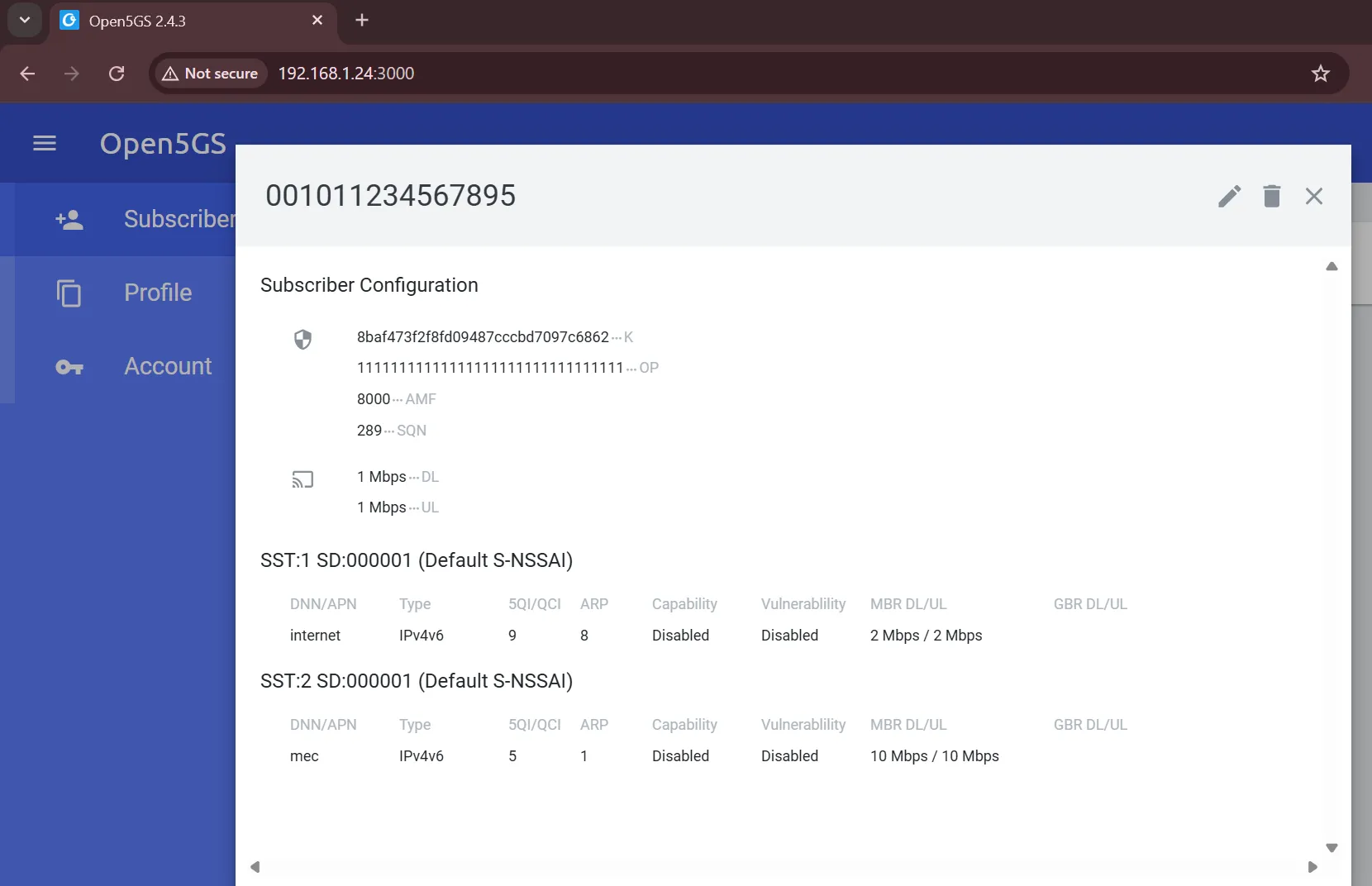
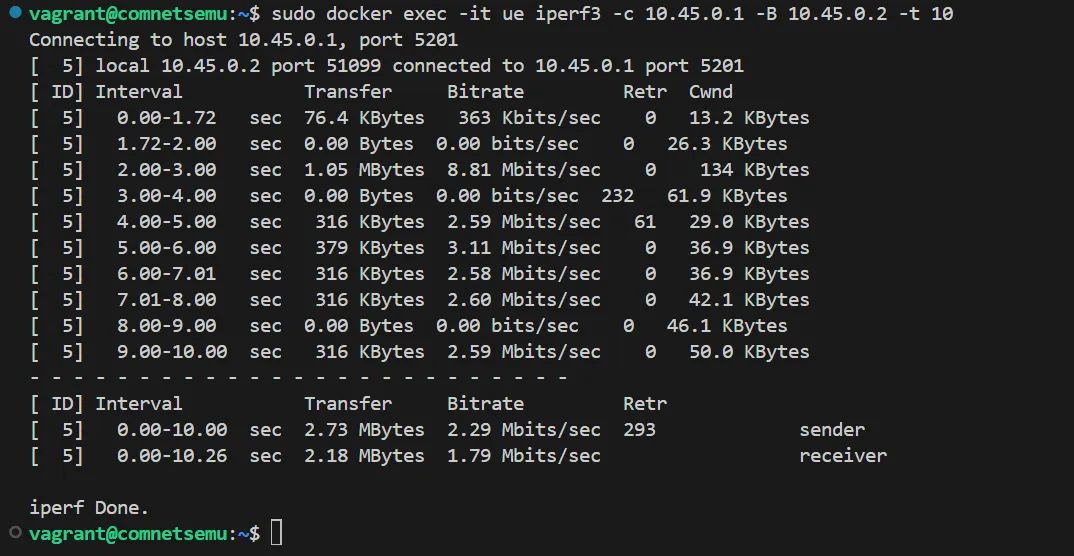
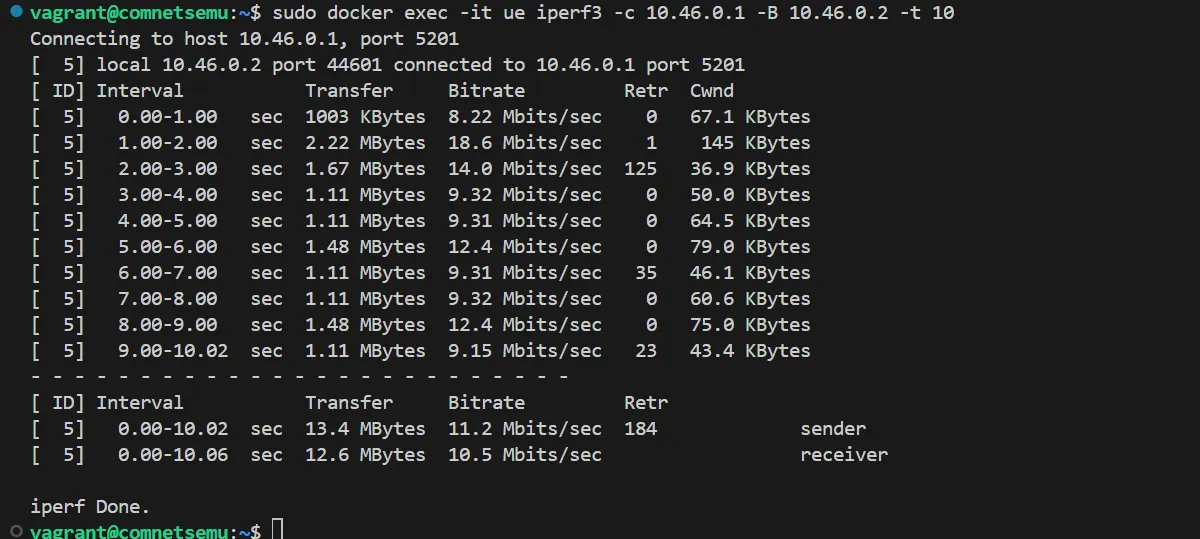
Screenshots taken from the project report. Lab environment (ComNetsEmu); the identifiers shown are the test values supplied with the lab repository.
What this project shows
Deploying modern 5G takes as much systems skill (Docker, orchestration, network troubleshooting) as telecoms knowledge. The figures above were measured in this lab environment: they validate the configuration, not production performance.
Context, approach and architecture
Context
5G is no longer only about radio: its core is software and cloud-native. The project aimed to deploy a full 5G Standalone core to concretely understand its components, their interactions and the network-slicing mechanism.
Approach
-
Deployed a 5G SA core with Open5GS: AMF, SMF, UPF, NRF, UDM and the other network functions.
-
Simulated access network (UE and gNB) with UERANSIM and two slices on shared infrastructure: Internet (SST 1, 2 Mbps AMBR) and MEC (SST 2, 10 Mbps AMBR), each with its own UPF.
-
Per-slice measurements: latency (ping) and throughput (iperf3), then the same tests with the Ryu SDN controller driving the switches over OpenFlow 1.3.
-
Solved concrete problems: container conflicts, service start-up ordering, residual network interfaces.
Architecture
- UERANSIM
- simulated UE and gNB
- AMF / SMF
- access and session management
- UPF ×2
- user plane: one UPF per slice (Internet, MEC)
- NRF / UDM
- discovery and subscriber data
- Ryu + OpenFlow
- SDN controller